Unified Operations: The Quiet Advantage That Separates Growing Companies from Struggling Ones
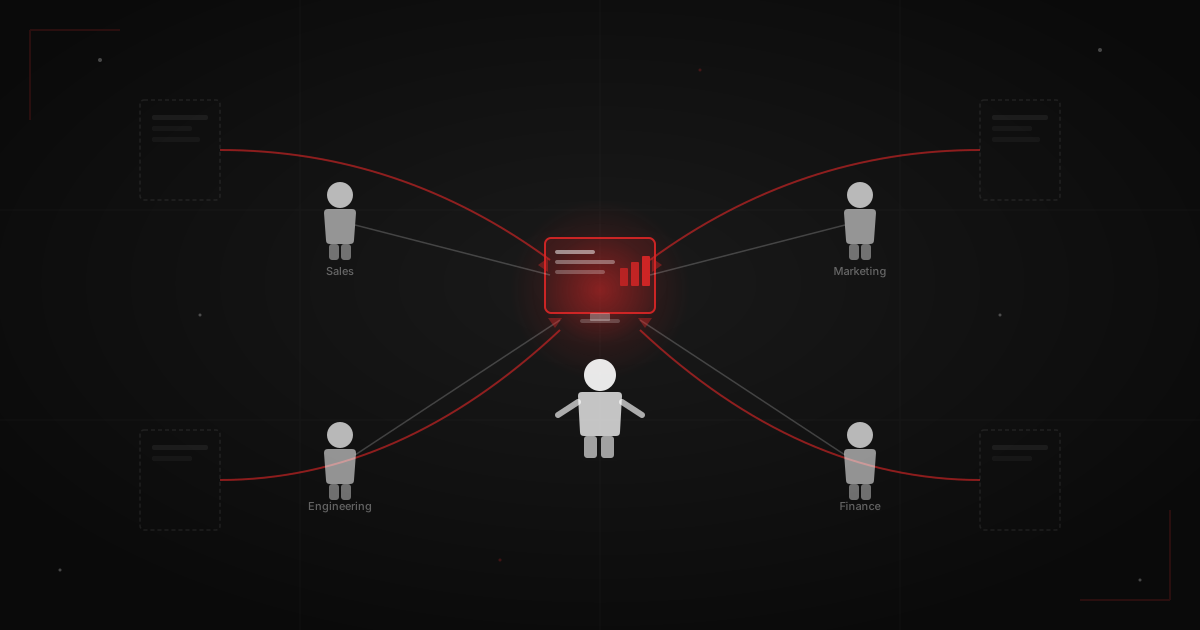
When a company stalls at 50 employees, or 100, or 200, the diagnosis almost always points to the same thing: not a lack of talent, not a lack of market, but a breakdown in how information moves between teams.
The founder can no longer hold the entire business in their head. The sales team doesn't know what delivery can handle. Finance doesn't have real-time visibility into project costs. HR is hiring for roles that were needed three months ago. Everyone is working hard, but in slightly different directions.
This is the operational ceiling. And it has nothing to do with how good your people are.
The Fragmentation Tax
Every growing company pays a fragmentation tax, though most don't realize it. It shows up in subtle ways:
A sales rep quotes a six-week delivery timeline because that's what it was last quarter. But delivery is now running at 120% capacity, and the real timeline is ten weeks. The client signs. The project starts late. Trust erodes.
Finance closes the books on the 15th of every month. But by then, two projects have already gone over budget. The P&L report is accurate but useless, it's a photo of a problem that started three weeks ago.
HR runs a hiring process for a senior developer. By the time the offer goes out, the project that needed that developer has been rescoped. The hire happens anyway because nobody connected the dots.
Each of these scenarios is a symptom of the same disease: teams operating on different information at different speeds.
What Unified Operations Actually Means
Unified operations doesn't mean one giant dashboard. It means one shared reality.
When sales closes a deal, the project setup begins with the correct scope, budget, and timeline already populated. When delivery logs progress, finance sees updated cost projections in real time. When HR identifies a skill gap, it's based on actual project demand, not a manager's best guess from a monthly planning meeting.
The key principle is this: data enters the system once and flows to every department that needs it, automatically, in real time, with full context.
The Compound Effect
Unified operations creates a compound effect that's difficult to see at first but impossible to ignore over time.
Decisions get faster. When everyone is looking at the same data, alignment happens naturally. You don't need a weekly sync to agree on priorities because the system surfaces them.
Mistakes get caught earlier. A project going over scope gets flagged when the first sign appears, not after the budget is blown. A cash flow gap gets predicted weeks out, not discovered when the bank balance drops.
Growth becomes smoother. Adding a new team member, a new client, or a new department doesn't require rewiring your processes. The system absorbs growth because the workflows are already connected.
Leadership gets clarity. Instead of assembling a picture from five different reports, founders and executives see the whole business in one view: revenue, delivery health, team utilization, cash position, and risk signals, all connected.
Why This Matters More for SMBs
Large enterprises solve this problem (partially) by hiring integration teams, buying middleware, and running quarter-long implementation projects. They can absorb the cost of fragmentation because their margins are large enough to hide it.
SMBs can't. Every hour an employee spends reconciling data between systems is an hour that could have gone toward revenue-generating work. Every decision made on stale information is a risk that a 100-person company feels much more acutely than a 10,000-person one.
For SMBs, unified operations isn't an optimization. It's survival infrastructure.
The Path Forward
The companies that break through the operational ceiling share a common trait: they stop treating tools as solutions to individual problems and start thinking about their business as a connected system.
Sales doesn't exist in isolation. Projects don't exist in isolation. HR and Finance don't exist in isolation. They're all parts of the same organism, and they need to operate that way.
The quiet advantage isn't about working harder or hiring faster. It's about making sure that when your company grows, the information flows grow with it. Seamlessly. Automatically. Without anyone having to copy-paste between tabs.
That's what separates the companies that scale from the ones that stall.